From Assumption to Risk to Issue: Why These Three Project Logs Must Work Together
From Assumption to Risk to Issue: Why These Three Project Logs Must Work Together
The Assumption Log, Risk Register, and Issue Log Are Not Separate Filing Cabinets
One of the easiest mistakes in project management is to treat the Assumption Log, Risk Register, and Issue Log as three independent administrative documents.
They are not.
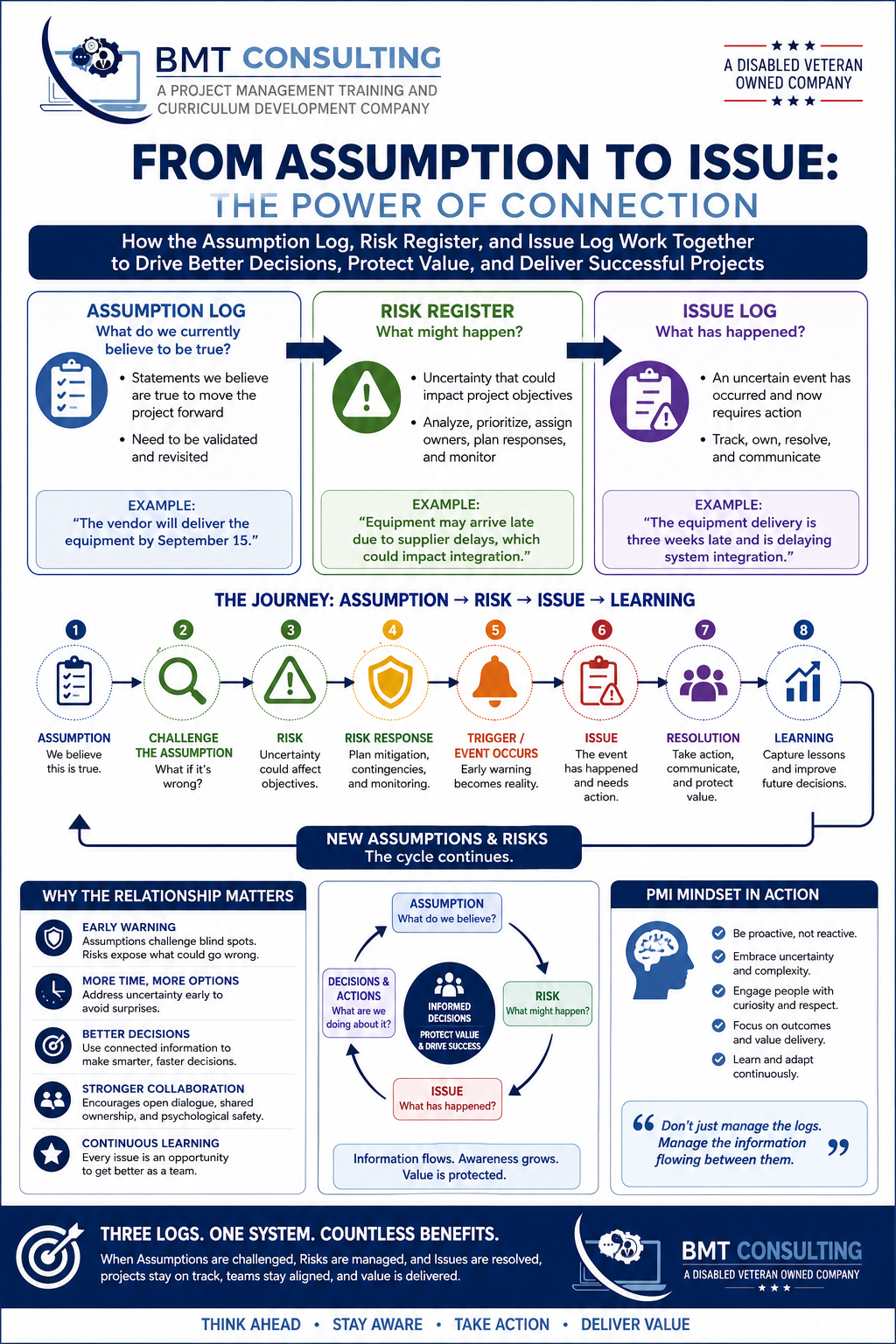
They represent three different states of project uncertainty and reality, and effective project managers understand how information can move between them throughout the project life cycle.
A simple way to think about the relationship is:
Assumption → Risk → Issue → Response → Learning
That progression is not inevitable. A good project team actively validates assumptions and manages risks precisely so that many uncertainties never become problems.
This is where the PMI Mindset becomes important. The purpose of these tools is not simply to document what happened. Their real value is helping the project team think ahead, collaborate, make informed decisions, respond to change, and protect value.
Three Tools — Three Different Questions
Before understanding the relationship, project managers need to understand what each tool is trying to answer.
Assumption Log — “What do we currently believe to be true?”
Projects cannot wait until every piece of information is known with certainty.
Planning therefore depends on assumptions.
Examples might include:
A key resource will be available in September.
A vendor will deliver equipment within six weeks.
Stakeholders will approve requirements within five business days.
An existing system can support the new solution.
Funding will remain available throughout the project.
A regulatory approval will be received before implementation.
These statements may be reasonable, but they are not necessarily facts.
That distinction matters.
The assumption log gives the project team a place to identify, document, communicate, validate, and revisit assumptions that influence project decisions.
A mature project team does not simply ask:
“What are our assumptions?”
It also asks:
“What happens if this assumption is wrong?”
That question creates the bridge between assumptions and risk.
The Risk Register — “What Might Happen?”
A risk represents uncertainty that could affect project objectives.
The risk register takes uncertainty and makes it actionable.
A project team might identify an assumption:
“The vendor will deliver the equipment by September 15.”
The team then evaluates the uncertainty surrounding that assumption.
What if the vendor cannot meet that date?
That could produce a risk:
“Because the supplier is experiencing manufacturing delays, the equipment may arrive after September 15, which could delay system integration and increase project costs.”
Now the team has moved beyond simply recording a belief.
It has identified uncertainty that could affect an objective.
The project team can now analyze the risk, assign ownership, determine appropriate responses, identify triggers, establish contingency actions, and continue monitoring it.
This is one of the most important relationships between the assumption log and risk register:
An assumption should never be allowed to quietly influence the project when its failure could significantly affect project objectives.
When the consequences matter, uncertainty deserves attention.
The Issue Log — “What Has Happened?”
This is where the distinction becomes critical.
A risk is uncertain.
An issue exists now.
Suppose the project team identified the vendor delivery risk and created contingency plans.
Then the vendor contacts the project manager:
“Production has been delayed. Your equipment will arrive three weeks late.”
The uncertainty is gone.
The event has occurred.
It is now an issue.
The project team should no longer spend its time discussing the probability that the vendor might be late.
That question has already been answered.
The team's focus shifts toward:
Impact
Ownership
Resolution
Escalation
Corrective action
Communication
Decision-making
Protection of project value
That is the role of the issue log.
The Relationship Looks Like This
Consider the progression:
Step 1 — Assumption
“The vendor will deliver the equipment by September 15.”
↓
Step 2 — Challenge the Assumption
“How confident are we, and what happens if this assumption proves false?”
↓
Step 3 — Risk
“The equipment may arrive late, delaying integration.”
↓
Step 4 — Risk Response
The team develops mitigation and contingency strategies.
↓
Step 5 — Trigger or Event Occurs
The vendor confirms a three-week delay.
↓
Step 6 — Issue
“The equipment delivery is three weeks late.”
↓
Step 7 — Issue Resolution
The team evaluates alternatives, implements corrective actions, communicates impacts, and updates affected plans.
↓
Step 8 — Learning
The team captures what was learned and applies that knowledge to future decisions, assumptions, risks, estimates, vendor management, and organizational knowledge.
This is not paperwork.
This is project intelligence moving through the project management system.
The Real Power Is in the Relationships
An inexperienced project manager may maintain all three artifacts perfectly and still manage the project poorly.
Why?
Because having the documents is not the same as using the information.
A stronger project manager sees relationships.
An assumption may create uncertainty.
Uncertainty may create risk.
A risk may become an issue.
An issue may force a decision.
That decision may change the schedule, budget, scope, resources, stakeholder expectations, or project approach.
Those changes may create new assumptions and new risks.
Therefore, this is not merely a straight line.
It is a continuous feedback loop.
Assumptions → Risks → Responses → Issues → Decisions → Changes → New Assumptions → New Risks
That feedback loop is far more representative of how projects actually operate.
Why This Relationship Matters More Today
Modern projects operate in environments characterized by complexity, rapid change, interconnected systems, distributed teams, emerging technology, vendor dependencies, changing customer expectations, regulatory uncertainty, and evolving business priorities.
Project managers cannot eliminate uncertainty.
Their job is to help the organization navigate uncertainty intelligently.
That makes the relationship between assumptions, risks, and issues extremely important.
Consider a digital transformation project.
The organization might assume employees will adopt a new system.
That assumption creates uncertainty surrounding adoption.
The team identifies a risk that employees may resist the new technology.
Early indicators begin appearing: low training attendance, negative stakeholder feedback, and poor participation in pilot testing.
Eventually, adoption problems begin affecting implementation.
What started as an assumption has developed into risk exposure and may ultimately become an active issue requiring intervention.
A project manager who views these artifacts independently may react too late.
A project manager who understands their relationship sees the warning signs developing.
That difference can determine whether the team is proactive or reactive.
The PMI Mindset: Don't Wait for the Problem
This relationship strongly supports the PMI Mindset.
Effective project management is not:
“Something went wrong. Who caused it?”
Instead, the project manager should encourage questions such as:
“What are we learning?”
“What has changed?”
“Which assumptions should we revisit?”
“Has our risk exposure changed?”
“What information does the team need?”
“Who should be involved in this decision?”
“What action best protects value?”
The PMI Mindset encourages project professionals to think beyond processes and focus on people, collaboration, adaptability, stewardship, systems thinking, uncertainty, and value delivery.
The logs support that mindset when they are used as decision-making tools rather than compliance artifacts.
The Assumption Log Is an Early-Warning System
This is one of the most overlooked ideas in project management.
The assumption log should not be created during planning and forgotten.
Assumptions need owners, attention, and periodic validation.
Imagine the project plan assumes that five developers will remain assigned throughout execution.
Three months later, leadership begins considering moving two developers to another strategic initiative.
Nothing has happened yet.
But something has changed.
A proactive project manager revisits the assumption.
The question becomes:
“Is this assumption still valid?”
If confidence is declining, the project manager may identify or update the associated resource risk before the reassignment actually occurs.
This creates time.
And time creates options.
That is why assumption management can become an early-warning capability.
The Risk Register Is a Decision Tool
The risk register should not become a graveyard containing dozens of risks nobody discusses.
Its purpose is to help the project team decide:
What deserves attention?
What uncertainty matters most?
Who owns the risk?
What should we do about it?
What triggers should we monitor?
What response should occur if conditions change?
What opportunities should we pursue?
Is the current exposure acceptable?
The risk register connects uncertainty to action.
This is especially important because risks are not limited to threats.
Uncertainty can also create opportunities.
An assumption that proves better than expected could create an opportunity to accelerate delivery, reduce cost, increase benefits, or expand value.
The PMI Mindset therefore asks the project manager to look at uncertainty from both directions.
The Issue Log Is an Action Tool
When something becomes an issue, documentation alone provides little value.
Issues require action.
A useful issue log helps establish:
What happened
When it happened
Who owns it
What objectives are affected
How urgent it is
What actions are required
Whether escalation is necessary
What decisions have been made
Current status
Target resolution
Actual resolution
But there is another important step.
Look backward.
When an issue occurs, ask:
Was there an assumption we should have challenged?
Was this previously identified as a risk?
Were warning signs missed?
Was the response appropriate?
Did we wait too long to act?
Those questions transform issue management into organizational learning.
The Logic Bomb: Every Issue Has a History
Here is the concept project managers should remember:
Many project issues do not suddenly appear. They have a history.
Before the issue, there may have been a risk.
Before the risk, there may have been an assumption.
Before the assumption, there may have been incomplete information.
The project manager's responsibility is not to predict the future perfectly.
That is impossible.
The responsibility is to build an environment where the team is willing and able to surface uncertainty early enough to do something about it.
That is a completely different way of thinking about project control.
Don't Punish the Messenger
There is also a people component that cannot be ignored.
These tools only work when people are willing to tell the truth.
If team members fear being blamed for raising concerns, risks remain hidden.
If stakeholders are punished for challenging assumptions, assumptions become artificial facts.
If bad news is discouraged, issues stay invisible until their impact becomes unavoidable.
Psychological safety therefore becomes part of effective risk and issue management.
The project manager should create an environment where someone can say:
“I don't think that assumption is valid anymore.”
And the response should be curiosity—not defensiveness.
That is PMI-aligned leadership.
Predictive, Agile, and Hybrid Projects All Need This Thinking
The terminology and artifacts may vary depending on the development approach, but the thinking remains valuable.
Predictive Environment
Formal assumption logs, risk registers, and issue logs may be maintained and regularly reviewed.
Agile Environment
The same information may appear through impediment boards, risk-adjusted backlogs, information radiators, retrospectives, daily discussions, product backlog items, or team working artifacts.
Hybrid Environment
Teams may combine formal governance artifacts with adaptive team-level tools.
The PMI Mindset does not say:
“Always use this exact document.”
The stronger question is:
“What information does the team need to make good decisions?”
Tailor the tool.
Do not abandon the thinking.
A Practical Review Cycle for Project Managers
A strong project manager can connect these artifacts through a recurring review cycle.
1. Review Assumptions
Ask:
Is this still true?
What evidence supports it?
Has anything changed?
What happens if it proves false?
2. Identify or Reassess Risks
Ask:
What uncertainty does this create?
Has probability changed?
Has impact changed?
Are there new threats or opportunities?
Are existing responses still appropriate?
3. Watch Triggers
Ask:
What would tell us the risk is getting closer?
Are early warning indicators appearing?
4. Recognize Issues Quickly
Ask:
Has the uncertain event actually occurred?
If so, stop treating it as merely a future risk.
5. Respond
Determine ownership, action, escalation, communication, and resolution.
6. Update Connected Project Information
Changes may affect:
Schedule
Cost
Scope
Resources
Stakeholders
Quality
Procurement
Benefits
Other assumptions
Other risks
7. Learn
Ask:
“What should we do differently because of what we now know?”
That final question closes the feedback loop.
Project Management Is Not About Eliminating Uncertainty
One of the most important mindset shifts is understanding that successful project management does not require knowing everything.
Projects exist partly because organizations are trying to create something that does not yet exist.
There will always be uncertainty.
The goal is therefore not:
Eliminate uncertainty.
The goal is:
Make uncertainty visible early enough to make intelligent decisions.
The assumption log helps expose what the team believes.
The risk register helps expose what might happen.
The issue log helps expose what has happened and requires action.
Together, they create visibility.
And visibility creates better decisions.
Final Takeaway: Connect the Dots
The Assumption Log, Risk Register, and Issue Log should never become isolated administrative artifacts.
Think of them as interconnected components of the project's learning and decision system:
ASSUMPTION
What do we believe?
↓
RISK
What might happen because uncertainty exists?
↓
RESPONSE
What can we do before it happens?
↓
ISSUE
What has happened and now requires action?
↓
LEARNING
What should change because of what we learned?
↺
NEW ASSUMPTIONS & RISKS
That is the cycle.
And the strongest project managers do not simply maintain these tools.
They connect them.
They challenge assumptions before assumptions become vulnerabilities.
They identify risks before risks become surprises.
They monitor triggers before threats become crises.
They address issues before issues become project failures.
And they continuously feed what they learn back into the project.
That is where project management moves beyond administration and becomes leadership, stewardship, and value delivery.
The PMI Mindset Bottom Line
Don't manage the logs. Manage the information flowing between them.
The Assumption Log tells you what the team believes.
The Risk Register tells you what might happen.
The Issue Log tells you what has happened.
The project manager's real job is to recognize when information needs to move from one state to another—and help the team make the best possible decision before uncertainty threatens project value.
Assumptions create questions.
Questions expose uncertainty.
Uncertainty creates risk.
Risks demand decisions.
Some risks become issues.
Issues create learning.
Learning creates better assumptions.
That is not just documentation.
That is the PMI Mindset in action.