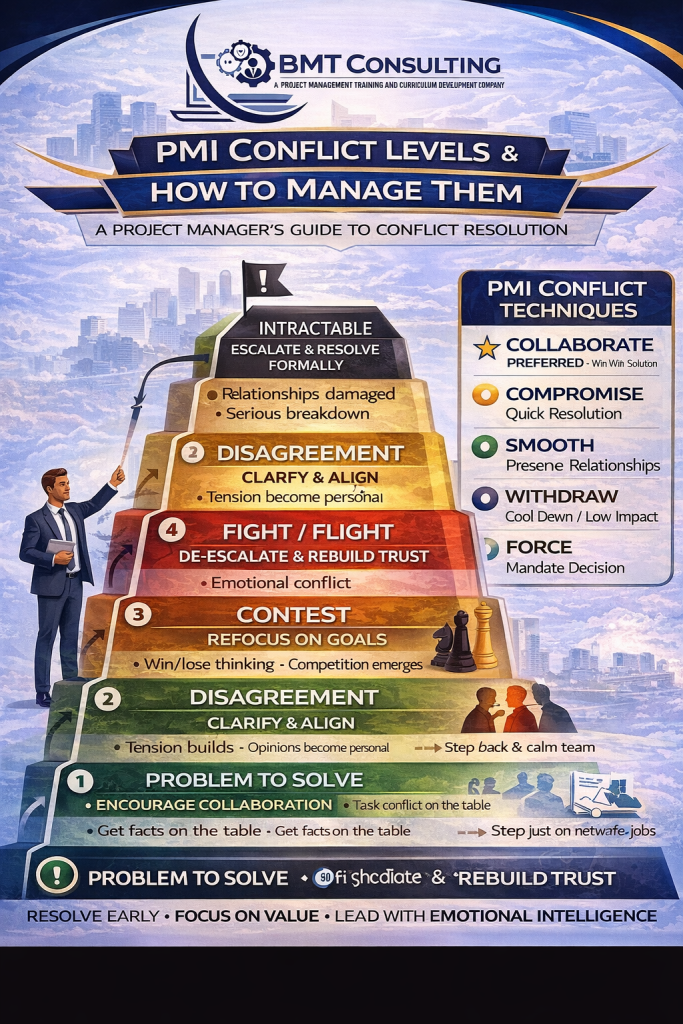
PMI Conflict Levels & How to Manage Them
PMI Conflict Levels & How to Manage Them
30 years combined experience
“A Project Managers’ Guide to Conflict Resolution”
Mastering Conflict Management in Project Management
Conflict is unavoidable in project environments—but according to the PMI (Project Management Institute) mindset, it is not something to fear. In fact, well-managed conflict leads to better decisions, innovation, and stronger team performance.
The key is understanding how conflict evolves and knowing how to respond at each level.
In this guide, you’ll learn:
The5 levels of conflict in project management
How conflict escalates if unmanaged
PMI-approved conflict resolution strategies
What a project manager should do at each stage
Real-world application for PMP & CAPM success
What Are the Levels of Conflict in Project Management?
Conflict typically progresses through five distinct levels, moving from constructive to destructive if not addressed early.
Understanding these levels is critical for:
Maintaining team performance
Preventing escalation
Protecting project outcomes
Level 1: Problem to Solve (Constructive Conflict)
What It Looks Like:
This is the most productive level of conflict. Team members openly discuss:
Different ideas
Technical approaches
Priorities or trade-offs
The focus remains on the work—not the people.
Example:
Two engineers debate the best design approach for scalability.
PMI Perspective:
PMI views this as healthy conflict that should be encouraged because it:
Improves decision-making
Encourages innovation
Strengthens team collaboration
How a Project Manager Should Respond:
Facilitate open dialogue
Ask clarifying questions
Ensure all voices are heard
Keep discussion fact-based
Recommended Technique: Collaborate (Problem Solving)
Pro Tip:
Never shut down this level of conflict—it’s where high-performing teams thrive.
Level 2: Disagreement (Early Tension)
What It Looks Like:
Conflict begins to shift slightly:
Tone becomes more emotional
Opinions feel more personal
Misunderstandings increase
Example:
A stakeholder feels their input is being ignored in planning discussions.
PMI Perspective:
Still manageable—but requires active facilitation to prevent escalation.
How a Project Manager Should Respond:
Clarify miscommunication
Re-anchor the team to shared goals
Encourage respectful discussion
Reinforce team norms
Recommended Techniques: Collaborate or Compromise
Warning Sign:
If left unmanaged, this level quickly escalates into win/lose thinking.
Level 3: Contest (Win/Lose Mindset)
What It Looks Like:
Individuals defend positions rather than solutions
“I’m right, you’re wrong” mentality emerges
Collaboration decreases
Example:
Team members argue over ownership instead of focusing on delivery.
PMI Perspective:
This is whereproject value begins to degrade.
How a Project Manager Should Respond:
Shift focus frompositions to outcomes
Reframe discussions aroundproject objectives
Encourage compromise where appropriate
Address behavior—not just the issue
Recommended Techniques: Compromise or Collaborate
Pro Tip:
At this level, emotional intelligence becomes critical—listen more than you speak.
Level 4: Fight or Flight (Emotional Conflict)
What It Looks Like:
Emotional reactions dominate
Team members avoid each other OR confront aggressively
Communication breaks down
Example:
A team member refuses to attend meetings due to conflict with another member.
PMI Perspective:
This level is dangerous to team cohesion and productivity.
How a Project Manager Should Respond:
Pause group discussions if needed
Address issues privately and professionally
Focus on restoring trust
Use active listening and empathy
Recommended Techniques: Smooth or Withdraw (temporarily)
Important:
You cannot solve emotional conflict with logic alone—address the human side first.
Level 5: Intractable Conflict (Breakdown)
What It Looks Like:
Relationships are damaged
No willingness to collaborate
Project performance is at risk
Example:
Two key stakeholders refuse to work together, impacting delivery.
PMI Perspective:
At this stage, conflict requires formal intervention.
How a Project Manager Should Respond:
Escalate to leadership or sponsors
Apply formal conflict resolution processes
Consider resource reassignment
Protect project objectives at all costs
Recommended Techniques: Force (last resort) or Escalation
Reality Check:
If conflict reaches this level, it indicates earlier opportunities to intervene were missed.
PMI Conflict Resolution Techniques (Deep Dive)
Understanding when to use each technique is critical for CAPM and PMP exam success.
Collaborate (Best Option)
Win-win solution
Requires time and trust
Builds long-term relationships
Compromise
Each side gives something up
Faster than collaboration
Useful under time pressure
Smooth (Accommodate)
Emphasize agreement over differences
Maintains harmony
Temporary solution
Withdraw (Avoid)
Step back to cool down
Useful for low-impact issues
Not a long-term solution
Force (Direct)
One side wins
Used in emergencies
Can damage relationships
PMI Mindset on Conflict Management
PMI emphasizes that project managers should:
Address conflict early and directly
Focus on project goals—not personal opinions
Use emotional intelligence to guide interactions
Promote a culture of respect and collaboration
Core Principle:
“The earlier you address conflict, the easier it is to resolve.”
Why Conflict Management Is Critical for Project Success
Benefits of Effective Conflict Management:
Better decision-making
Stronger team trust
Increased productivity
Higher stakeholder satisfaction
Risks of Poor Conflict Management:
Missed deadlines
Low morale
Communication breakdown
Project failure
Final Takeaway: Control the Conflict Before It Controls the Project
Conflict is not the enemy—mismanaged conflict is.
Great project managers:
Recognize early warning signs
Adapt their leadership style
Apply the right technique at the right time
Leadership Insight:
The best project managers don’t eliminate conflict—they leverage it for better outcomes.
To learn more go tohttps://www.bmtconsulting.net
“Resolve Early • Focus on Value • Lead with Emotional Intelligence”