The Future of Project Management: Generative AI & Automation
The Future of Project Management: How Generative AI & Automation Are Changing Everything
By BMT Consulting | Project Management • Generative AI • Automation • PMP • CAPM • PMI-ACP
Imagine starting your workday with your project status report already drafted, emerging risks identified, stakeholder updates prepared, and routine tasks automatically assigned—all before your first cup of coffee.
That may sound like a vision of the future, but AI and automation are already changing how project work is planned, communicated, monitored, and delivered.
For project managers, the question is no longer simply “Will AI affect project management?” The more useful question is:
“How can project professionals learn to work effectively with AI while continuing to provide the leadership, judgment, and human connection that projects require?”
At BMT Consulting, we believe the future belongs to AI-empowered project professionals—people who understand project management fundamentals while also learning how to leverage emerging technologies.
The Rise of Generative AI in Project Management
Generative AI has moved well beyond being a technology buzzword.
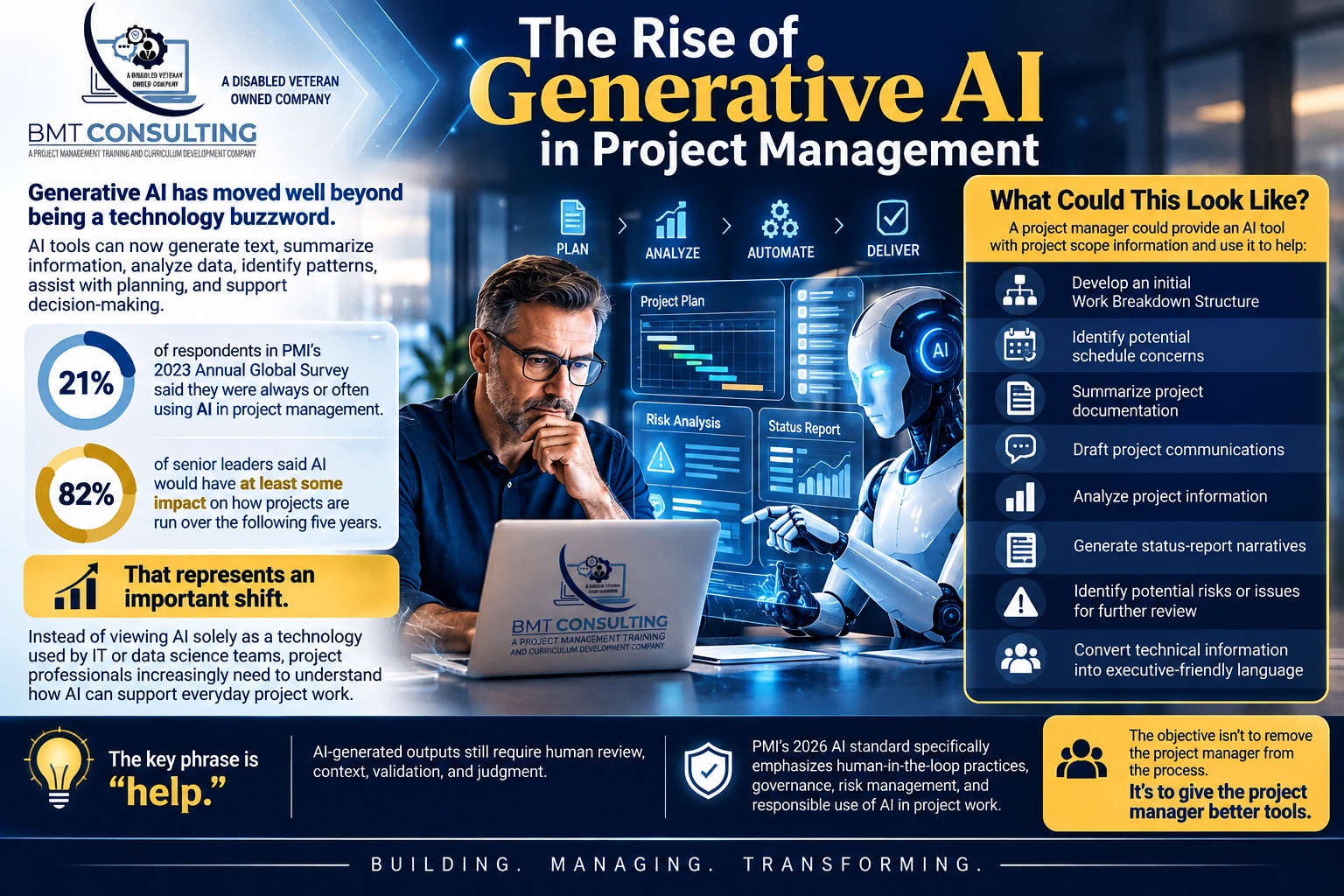
AI tools can now generate text, summarize information, analyze data, identify patterns, assist with planning, and support decision-making. PMI has reported that 21% of respondents in its 2023 Annual Global Survey said they were always or often using AI in project management, while 82% of senior leaders said AI would have at least some impact on how projects are run over the following five years.
That represents an important shift.
Instead of viewing AI solely as a technology used by IT or data science teams, project professionals increasingly need to understand how AI can support everyday project work.
What could this look like?
A project manager could provide an AI tool with project scope information and use it to help:
Develop an initial Work Breakdown Structure
Identify potential schedule concerns
Summarize project documentation
Draft project communications
Analyze project information
Generate status-report narratives
Identify potential risks or issues for further review
Convert technical information into executive-friendly language
The key phrase is “help.”
AI-generated outputs still require human review, context, validation, and judgment. PMI's 2026 AI standard specifically emphasizes human-in-the-loop practices, governance, risk management, and responsible use of AI in project work.
The objective isn't to remove the project manager from the process.
It's to give the project manager better tools.
Automation: The Engine Behind Intelligent Workflows
Generative AI can create and analyze information.
Automation helps execute the workflow.
Consider a project environment where a dependency changes.
Instead of relying entirely on someone to notice the change and manually communicate it, an automated workflow could potentially:
Detect the change.
Identify affected activities.
Notify the appropriate team members.
Update a workflow or dashboard.
Trigger an approval or review.
Escalate an issue when predefined conditions are met.
This is where AI and automation become particularly powerful when used together.
AI can help interpret information. Automation can help move work forward.
Organizations are already applying these concepts to project reporting. For example, PwC describes an AI-enabled PMO reporting solution designed to automate portions of status reporting and reduce manual administrative effort; its reported implementation example estimated approximately a 40% reduction in administrative project overhead.
The broader lesson is important:
Automation isn't about automating everything. It's about identifying repetitive work that doesn't require a project manager's highest-value skills and improving the workflow around it.
What Does This Mean for Project Managers?
This is where the conversation gets interesting.
Does AI replace project managers?
A more useful way to look at the issue is that AI is changing what project managers spend their time doing.
Project management has always involved more than schedules, status reports, meeting notes, and task assignments.
Project managers lead people.
They facilitate decisions.
They manage conflict.
They communicate with stakeholders.
They navigate uncertainty.
They interpret organizational priorities.
They build trust.
They make judgment calls when the information available is incomplete.
Those capabilities remain important in an AI-enabled environment.
In fact, PMI's current approach to AI in project management emphasizes responsible application, governance, human oversight, and value delivery. PMI published The Standard for Artificial Intelligence in Portfolio, Program and Project Management in June 2026, providing a framework for applying AI more systematically and responsibly to project work.
That means project professionals should think about AI as another capability to develop—not simply as another software tool to learn.
AI Fluency Is Becoming an Important Project Management Skill
Project managers don't necessarily need to become software engineers or data scientists.
But they increasingly need to understand:
What AI can and cannot do
How to write effective prompts
How to evaluate AI-generated information
How to protect sensitive project information
How to identify AI-related risks
How to incorporate human review
How to automate appropriate workflows
How to communicate AI-generated insights
How to maintain accountability for project decisions
PMI's research has highlighted a significant skills gap: only about 20% of project managers surveyed reported extensive or good practical experience with AI tools and technologies, while 49% reported little to no experience or understanding of AI in project management.
That creates an opportunity for project professionals willing to build these skills.
AI Is Also Changing Project Management Certification
The evolution of project management certifications reflects the changing environment.
PMI's 2026 PMP examination update explicitly adds AI, sustainability, and stakeholder engagement to project-based scenarios while placing greater emphasis on outcomes, value, business impact, and real-world project dynamics.
This is an important signal for anyone preparing for a PMP certification.
The profession is not moving away from project management fundamentals.
Instead, those fundamentals are being applied in a world where technology, AI, automation, adaptive approaches, and business transformation are increasingly part of the project environment.
For aspiring project professionals, certifications such as PMP®, CAPM®, and PMI-ACP® can provide a foundation of project management knowledge that can then be combined with emerging AI and automation capabilities.
What Could Project Management Look Like by 2030?
The workplace is changing rapidly.
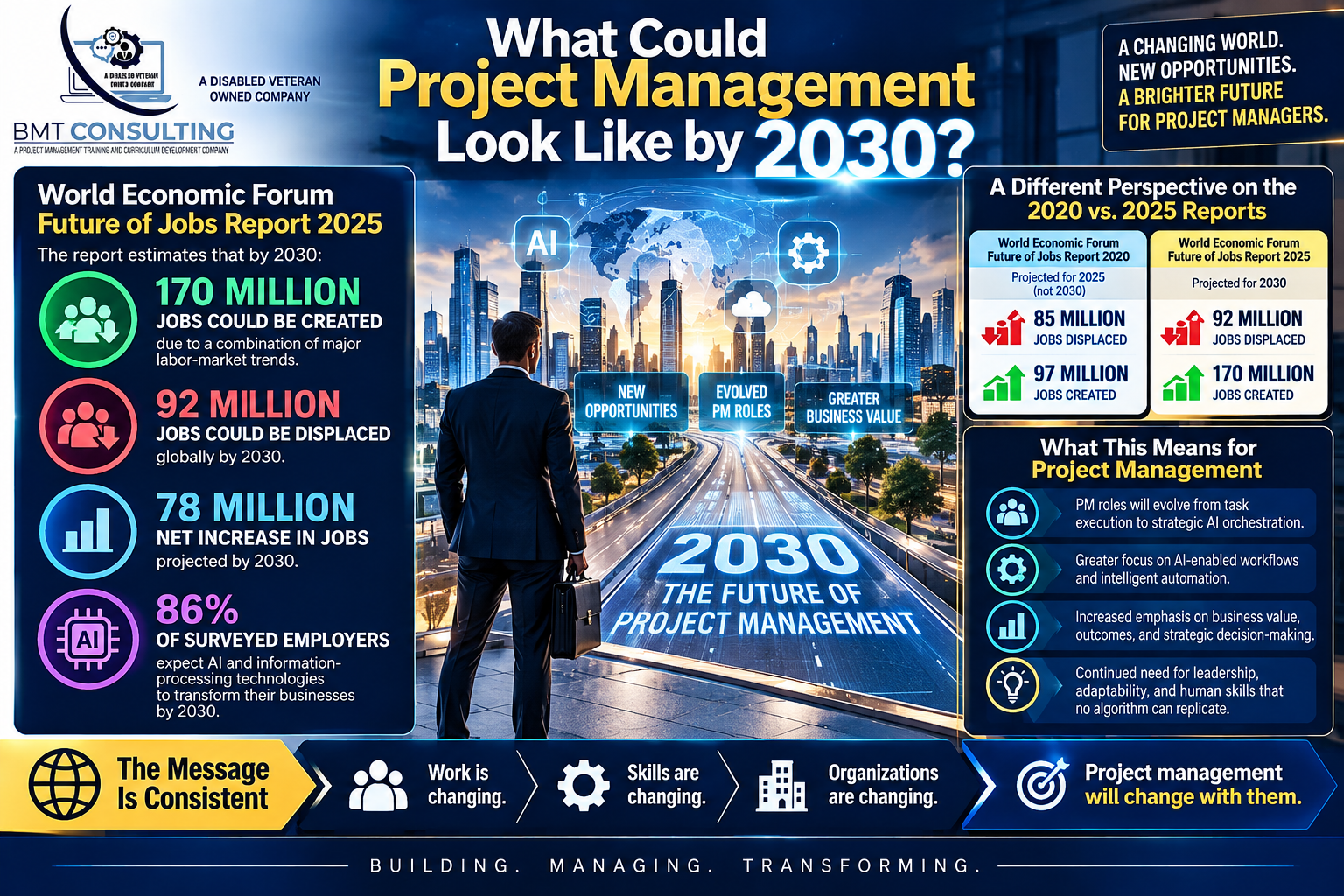
The World Economic Forum's Future of Jobs Report 2025 estimates that 170 million jobs could be created and 92 million displaced globally by 2030 due to a combination of major labor-market trends, for a net increase of 78 million jobs. The report also says 86% of surveyed employers expect AI and information-processing technologies to transform their businesses by 2030.
One important clarification: the often-repeated statistic that 85 million jobs will be displaced and 97 million created comes from the World Economic Forum's 2020 Future of Jobs Report, which projected those figures for 2025—not 2030.
The newer 2025 report provides a different outlook for 2030.
And the message from both reports is consistent:
Work is changing. Skills are changing. Organizations are changing.
Project management will change with them.
The Project Manager of the Future
The project manager of the future may spend less time performing repetitive administrative tasks and more time orchestrating people, technology, information, and business outcomes.
Imagine a project environment where AI helps:
Monitor → Analyze → Predict → Recommend → Automate
while the project manager provides:
Leadership → Judgment → Accountability → Communication → Strategy
That combination could become one of the defining characteristics of modern project management.
The strongest project professionals won't necessarily be those who use the most AI tools.
They will be those who understand when to use AI, when not to use it, how to validate its output, and how to integrate it into a human-centered project environment.
The Future Isn't AI vs. Project Managers
The future conversation shouldn't simply be:
“Will AI replace project managers?”
A better question is:
“How will project managers use AI to become more effective?”
Generative AI and automation can help reduce repetitive work, accelerate information processing, improve workflow visibility, and support decision-making.
But projects are ultimately delivered by people.
Successful project professionals will still need to understand leadership, stakeholder engagement, communication, conflict management, risk, uncertainty, value delivery, and organizational strategy.
AI can provide capabilities.
Project managers provide leadership and accountability.
That combination could define the next generation of project management.
Prepare for the Future of Project Management
If you're working toward your PMP®, CAPM®, or PMI-ACP® certification, now is an excellent time to think beyond simply passing an exam.
Build a foundation in project management.
Develop your leadership and communication skills.
Learn how AI works.
Experiment with responsible AI applications.
Understand automation.
And most importantly, learn how to combine technology with the PMI Mindset and human-centered leadership.
At BMT Consulting, our goal is to help project professionals become certification-ready and future-ready.
Explore our project management training and certification preparation resources at:
pmiacp.bmtconsulting.net
Building. Managing. Transforming.
The future of project management isn't about choosing between people and technology.
It's about learning how to bring them together.
AI may change how the work gets done.
Project professionals will continue to determine why the work matters, how value is delivered, and how people move forward together.
The future is already here.
Are you ready for it?
Click here to see a quick video about this on our YouTube Page: